Saturday, 16 October 2010

Mushroom hunt - with the camera

We had indeed, as promised, some Indian Summer days recently. The weather is dry since over a week, with some cool nights. But even when the sun is out my garden doesn’t get much of it. The sun is so low now that the old trees around the garden let it in only for a few hours in the afternoon.

This year we had a kestrel pair breeding in one of these nests:


At this time of the year I like to walk under the trees with my eyes on the forest floor looking out for mushrooms. When I was at that I found another nest in this tree stump here:


It looks to me like a partially destroyed, partially rebuilt wasps’ nest. There were signs of some disturbance around the tree stump. What do others think? I didn’t go too near, as there was still some wasp activity:


I don’t look for mushrooms to eat them. I wouldn’t know which ones are edible, and so many in the books and in reality look very similar, especially those with gills. I know that this one shouldn’t be tried:


There was no sign of it ten days ago, meanwhile several of these have popped up. That’s one of the things that amaze me with mushrooms. How they seem to appear fairly suddenly, stay for a while, and then there’s no sign of the underground organism that produces them again for most of the year.

I also like how searching for them makes you look closely on the forest floor and all that is there, and to walk slowly and carefully so that none that are hidden under and between vegetation and debris get damaged.

I nearly overlooked this one because of its grey colour.


I wonder who has found it edible. Like this one:


So, I don’t hunt mushrooms for eating, but I know some mushrooms can be used for dyeing wool. (Especially Cortinarii/Dermocybe types; and Hapalupilus nigulans, which I didn’t find in my book.) In any case, if someone can identify some of the mushrooms here, please let me know.

I tried one type for dyeing, will come to it later. First a few more specimens that I found under the old trees:


The next two are all fairly small.


And these two seem to belong to a different group:


There were several days between the following two shots. See how this one has overgrown one of the twigs. The pictures were taken from a slightly different position.


Same difference in time here as well (I removed the stick later):


The next two are boletes, that I know:


I got the idea to go into the forestry beside us and see what I would find there. Hadn’t been there for several years. I never liked it and kind of tried to ignore it since it has become very dominant. It was impossible to walk into it when the young trees had started to grow together. Now you can crawl in and when you bend down you can walk around between and under the dry and dead lower branches.


When I had entered I thought I’m in another world. It was really spooky, especially when I remembered what was there before the afforestation. The darkness, which the camera lightened up, and nothing on the ground except needles, needles, needles, and indeed: quite some amount of mushrooms:


See the white stuff everywhere? That’s a fungus as well I assume?


I found these ones at the edge of the forestry:


There was some amount of these old black ones. Most were really hard and dry, some already detached.


I decided I try some of these for dyeing. When I washed them they got soft again and somewhat more brownish:
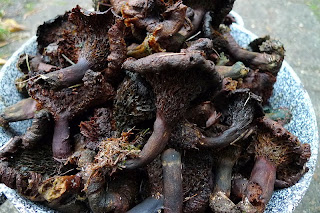


That's the colour I got. Alum and iron mordants made no difference to it. I’d like to know what type of mushrooms I’ve used here.


Saturday, 2 October 2010

why no knitting in September 2010

I know I didn’t write a word here for more than four weeks or so.
I admit I didn’t knit anything for the same amount of time.

First I was occupied with decluttering my house, then I had my mum and brother visiting, which was great and an intense time that doesn’t happen too often.

I also did take part in the “Landing in Leitrim” poetry workshop in the Dock in Carrick on Shannon. This was a great experience. Alice Lyons, who chaired the course, was a very sensitive teacher. Whilst before the course, given that I was not up to now a poetry reader, I was very uncertain that I could achieve anything in the English language in poetry. Here’s just my first poem I wrote. The task was to write about a place that has various layers of memory to us, and just let it flow. Given what I did in the house I just wrote about it.


Decluttering


Am writing in a hurry.
Started to declutter,
clean,
paint,
refurbish.
My mum and brother visit soon.
Some rooms should be wellcoming.

Kept postponing it.
Knew it would take much time.
After so many years
of changing
circumstances,
activities,
household members,
visitors,
improvisations,
adjustments,
ideas,
politics,
economics.
Not enough
continuity.

Keep making lists of what to do next.

The house was never the main thing.
Some people fondly
renovate,
decorate,
buy and sell,
build
houses.
For me the place is important,
the outside.
Commonly carried in with boots,
the camera,
cats,
and formerly dogs.

Found some of the old dog licences in a drawer and cried.
They had arrived first after us.
A gift.
By someone unknown.
Dirty mangy little puppies. Brothers.
They left us again forever a few years ago.
Weren’t we pictured with them for the papers.
They were still with us then.

Too many layers of memories here for one poem.
So many signs,
things,
relics,
successful
and unfinished
projects.
Stuff that is now redundant.
Things that were kept in case some time in the future…

I used to live in the present
and look to the future.
Have got somewhat retrospective though,
in recent years.

It’s great to throw things out
now,
and update.
For the future.


Alice managed to encourage us, and at the moment I see writing poetry not so much different from knitting
Kind of using the material of language creatively to express what’s in the mind, and, as in any craft, there are methods that can be used to help this.

I also visited the Giant’s Causeway for the first time last Sunday. My brother is working with stone, making and carving tomb stones and similar. So he is always interested in how stones were formed in time. While I was really impressed by the architecture and patterns in the basalts, now there for us to see after 60 million of years. (A poem may result from this visit.) They were formed after volcanic eruptions that resulted from tectonic movements. Ireland wasn't where it is now on the globe then. The Atlantic Ocean was just to emerge from these movements. The same activity is still ongoing in it and in Iceland, which gave us the ash cloud earlier this year. The lava at the Giant's Causeway then cooled slowly because there was a river or similar; that water slowed cooling. That made the column structures possible.


the amphitheatre


some of the organs


I think this is one of the giants eyes, in this case it resulted from "onion skin" weathering


Part of the actual giant's causeway, on which you can walk and everyone of the many visitors does


more of these amazing stepping stones, those in the foreground are called the "honeycombs"


Friday, 20 August 2010

What fleece is this?

Anyone knows the creature that carries this fleece?


I found several ones in my garden, and when I showed one to my husband he said it looks like a tiny shrivelled up mouse:


Opening it up for a post mortem revealed what can be seen in the next pictures.


Well, "post mortem" is certainly not the right expression. It can still reproduce.

Monday, 16 August 2010

What's on my needles - August 2010

Yesterday we had summer, a beautiful "Sunday". July - and August so far - were dull and often autumn-like. July was reported as one of the wettest on record in Ireland. It didn't feel like that here, there wasn't such large amount of rain, but it was constantly damp without much sun.
But we wouldn't complain, we are happy not to suffer from weather extremes as people do in other countries like Russia and mainly Pakistan at the moment. Am I not lucky to be able to write this now, sitting in a dry room, show pictures of my garden, and of course, to knit?
I'm still doing a lot of double knitting, trying out new patterns in small things like little sachets and purses for example, making some little tapestries as well. Was it yesterday's sun that made me start this piece?


I then realised the different sunny shapes that I can find in the garden, such as the centre of this poppy flower.


Some of the poppies were so wet for so long that their bud walls had got black and were sticking together now. I had to help them to open their flowers by cautiously removing these sticky capsules. My garden is certainly particularly damp because of the trees that surround it. The Mesembryanthemums (is this the right name? In German "Mittagsblumen" - midday flowers) were looking as if to wait for "the" sun since a month or so to flower, and yesterday - finally - some of their flowers opened.


Here I found other suns in dill weed's flowers,


straw flowers


marigolds.


and in Cosmos, which is there again. I had saved seeds of the darkest purple flowers last year. Most of them are purple this year, but some are white again.


These are just some of the "suns" shining around here. I'm also always amazed by the textile fibres in some plants, such as in this willow herb.


All the shapes and forms in the plant world amaze me. Here are the seed pots of Aquilegias; even when they are dry and grey and brown, but full of seeds waiting to be shed, they impress.


One of my tapestries was inspired by them, when they were still green, though.


Their other side always looks different, with the colours inverted.


This one was inspired by where I pictured it: The patterns of ivy stems growing at a wall.


Here are Aquilegia pods from another perspective. The shapes and patterns seen in this picture will make it into another little tapestry I feel.


Saturday, 31 July 2010

Lavendelschaf/Lavender Sheep


No this is not a new, or rare sheep breed, but a German magazine I’ve been reading for many, many years. Its subtitle describes its contents: herbs, textiles, nature.

It is the brain child of Erdmute Marciniak, who I’ve never met, but who lives not too far from where I did before I left Germany. She is the responsible producer, editor and coordinator of Lavendelschaf.

The magazine is published four times a year, and the spring issue contained my first contribution, an article about the Hyperbolic Crochet Coral Reef Project, having contributed to the Irish Reef here. Lavendelschaf is indeed similar to this project, as it has contributions from many people with love and enthusiasm for textiles, handicrafts, nature, food and cooking by people who happily share information, their experiences, knowledge and expertise.

Sheep do of course feature in it. Apart from Rita Lüder’s charming cartoons there is in each issue an article about a special fibre, and often that is wool from a specific sheep breed. Each time, when you open these pages, you find a small sample of these fibres in the magazine. I feel this is a great idea, and shows the spirit of the project Lavendelschaf well.

As does the fact that every issue has a theme that guides contributors and collects all sorts of information and projects they come up with in relation to it. So I felt my article about the Coral Reef project was probably fitting, as the theme was “Meeresbriese/ sea breeze”, and Erdmute agreed.
Another characteristics is the front page that unites all contributions in a single picture.

The next issue’s theme is “Bärenstark/ strong as a bear”, and will contain an instruction written by me to make a small bear hand puppet for children. The issue for winter will be about “Sternstunden/ sidereal hours”, and I’ll take part in this as well.